Hvem daterte Barbara Villiers, 1. hertuginne av Cleveland?
John Churchill, 1st Duke of Marlborough datert Barbara Villiers, 1. hertuginne av Cleveland fra ? til ?. Aldersforskjellen var 9 år, 6 måneder og 9 dager.
Charles II of England datert Barbara Villiers, 1. hertuginne av Cleveland fra til . Aldersforskjellen var 10 år, 5 måneder og 19 dager.
Barbara Villiers, 1. hertuginne av Cleveland

Barbara Palmer, 1. hertuginne av Cleveland, opprinnelig Barbara Villiers, (født 27. november 1640, død 9. oktober 1709) var en kongelig kurtisane og én av Karl II av Englands mest kjente elskerinner.
Hun ble gift 14. april 1659 med Robert Palmer (1634–1705), den senere jarl av Castlemaine. Paret ble separert i 1662 rett etter at hun hadde fått en sønn. Ekteparet skilte seg aldri.
Barbara Palmer fikk seks barn med Karl II:
- Anne Palmer (1661–1722)
- Charles Fitzroy (1662–1730)
- Henry Fitzroy (1663–1690)
- Charlotte Fitzroy (1664–1718)
- George Fitzroy (1665–1716)
- Barbara Fitzroy (1672-1737; kongen anerkjente henne som sin datter, men det var antagelig John Churchill som var faren.)
John Churchill, 1st Duke of Marlborough
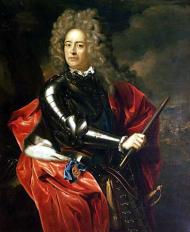
John Churchill (født 26. mai 1650 i Ashe House i Devon, død 16. juni 1722 i Windsor Lodge ved Windsor Castle) var en engelsk offiser og adelsmann. Han var den første hertug av Marlborough. I tillegg hadde han titlene kaptein-general, jarl av Marlborough, baron Churchill av Sandridge, lord Churchill av Eyemouth, ridder av Order of the Garter, medlem av Det kongelige råd, fyrste av Mindelheim og prins av Det hellige romerske rike av den tyske nasjon. Han regnes gjerne for å være Storbritannias største militære geni og utmerket seg spesielt i den spanske arvefølgekrigen. Historikeren Edward Casey skrev om ham at han «aldri utkjempet et slag han ikke vant, og aldri beleiret et sted han ikke tok».
Drikkevisen «For he's a jolly good fellow» handler egentlig om ham. Den går nemlig på melodien til den franske soldatsangen «Malbrouk s'en va t'en guerre» (= Marlborough dro i krigen ut). Sangen ble lenge sunget i Frankrike, det hevdes at Marie Antoinette sang den for sine barn. Også engelskmennene overtok den, men med sin egen tekst.
Les mer...Barbara Villiers, 1. hertuginne av Cleveland
Charles II of England
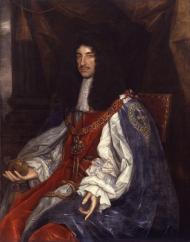
Charles II (29 May 1630 – 6 February 1685) was King of Scotland from 1649 until 1651 and King of England, Scotland, and Ireland from the 1660 Restoration of the monarchy until his death in 1685.
Charles II was the eldest surviving child of Charles I of England, Scotland and Ireland and Henrietta Maria of France. After Charles I's execution at Whitehall on 30 January 1649, at the climax of the English Civil War, the Parliament of Scotland proclaimed Charles II king on 5 February 1649. However, England entered the period known as the English Interregnum or the English Commonwealth with a republican government eventually led by Oliver Cromwell. Cromwell defeated Charles II at the Battle of Worcester on 3 September 1651, and Charles fled to mainland Europe. Cromwell became Lord Protector of England, Scotland and Ireland. Charles spent the next nine years in exile in France, the Dutch Republic and the Spanish Netherlands. A political crisis after Cromwell's death in 1658 resulted in the restoration of the monarchy in 1660, and Charles was invited to return to Britain. On 29 May 1660, his 30th birthday, he was received in London to public acclaim.
Charles's English Parliament enacted the Clarendon Code, to shore up the position of the re-established Church of England. Charles acquiesced to these new laws even though he favoured a policy of religious tolerance. The major foreign policy issue of his early reign was the Second Anglo-Dutch War. In 1670, he entered into the Treaty of Dover, an alliance with his cousin, King Louis XIV of France. Louis agreed to aid him in the Third Anglo-Dutch War and pay him a pension, and Charles secretly promised to convert to Catholicism at an unspecified future date. Charles attempted to introduce religious freedom for Catholics and Protestant dissenters with his 1672 Royal Declaration of Indulgence, but the English Parliament forced him to withdraw it. In 1679, Titus Oates's fabrication of a supposed Popish Plot sparked the Exclusion Crisis when it was revealed that Charles's brother and heir presumptive, James, Duke of York, had become a Catholic. The crisis saw the birth of the pro-exclusion Whig and anti-exclusion Tory parties. Charles sided with the Tories and, after the discovery of the Rye House Plot to murder Charles and James in 1683, some Whig leaders were executed or forced into exile. Charles dissolved the English Parliament in 1681 and ruled alone until his death in 1685.
A patron of the arts and sciences, Charles became known for his affability and friendliness, and for allowing his subjects easy access to his person. But he also showed an almost impenetrable reserve, especially concerning his political agendas. His court gained a reputation for moral laxity. Charles's marriage to Catherine of Braganza produced no surviving children, but the king acknowledged at least 12 illegitimate children by various mistresses. He was succeeded by his brother James.
Les mer...