Hvem daterte Mark Antony?
Glaphyra datert Mark Antony fra ? til ?.
Volumnia Cytheris datert Mark Antony fra ? til ?.
Mark Antony
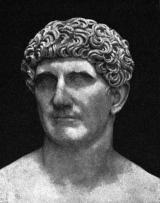
Marcus Antonius (14 January 83 BC – 1 August 30 BC), commonly known in English as Mark Antony, was a Roman politician and general who played a critical role in the transformation of the Roman Republic from a constitutional republic into the autocratic Roman Empire.
Antony was a relative and supporter of Julius Caesar, and he served as one of his generals during the conquest of Gaul and Caesar's civil war. Antony was appointed administrator of Italy while Caesar eliminated political opponents in Greece, North Africa, and Spain. After Caesar's assassination in 44 BC, Antony joined forces with Lepidus, another of Caesar's generals, and Octavian, Caesar's great-nephew and adopted son, forming a three-man oligarchy known to historians as the Second Triumvirate. The Triumvirs defeated Caesar's killers, the Liberatores, at the Battle of Philippi in 42 BC, and divided the government of the Republic among themselves. Antony was assigned Rome's eastern provinces, including the client kingdom of Egypt, then ruled by Cleopatra VII, and was given the command in Rome's war against Parthia.
Relations among the triumvirs were strained as the various members sought greater political power. Civil war between Antony and Octavian was averted in 40 BC, when Antony married Octavian's sister, Octavia. Despite this marriage, Antony carried on a love affair with Cleopatra, who bore him three children, further straining Antony's relations with Octavian. Lepidus was expelled from the association in 36 BC, and in 33 BC, disagreements between Antony and Octavian caused a split between the remaining Triumvirs. Their ongoing hostility erupted into civil war in 31 BC, when Octavian induced the republic to declare war on Cleopatra and proclaim Antony a traitor. Later that year, Antony was defeated by Octavian's forces at the Battle of Actium. Antony and Cleopatra fled to Egypt, where, having again been defeated at the Battle of Alexandria, they died by suicide.
With Antony dead, Octavian became the undisputed master of the Roman world. In 27 BC, Octavian was granted the honorific title of Augustus, marking the final stage in the transformation of the Republic into a monarchy, with himself as the first Roman emperor.
Les mer...Glaphyra
Glafyra (gresk: Γλαφύρα) var en gresk hetære eller kurtisane på 100-tallet f.Kr. Hun var fra Kappadokia i Anatolia av uklar bakgrunn. Glafyra var kjent og feiret i antikken for sin skjønnhet, sjarme foruten at hun også hadde et rykte for å være forførende.
Hun var gift med en framstående greker fra Kappadokia ved navn Arkelaos, yppersteprest ved tempelet og hersker i byen Komana. Han tjente den romerske krigsgudinnen Bellona. Via sin mann var antagelig Glafyra herskerinne av Komana. Arkelaos' far hadde samm navn, som døde i 55 f.Kr., hadde samme posisjon i Komana, og skal ha vært i samme slekt som Mitridates VI av Pontos (død 63 f.Kr.).
Glafyra fødte Arkelaos to sønner:
- Arkelaos Sisines, også kjent som den siste kongen av Kappadokia fra 36 f.Kr. og til sin død i 17 f.Kr.
- Sisines
I 47 f.Kr. sørget den romerske hærføreren Julius Cæsar, etter å ha beseiret sin fiende Pompeius, å avsette og frata Arkelaos hans posisjon som yppersteprest og hersker over Komana. Arkelaos ble erstattet av en annen gresk adelsmann ved navn Lykomedes. Pompeius hadde vært familiens beskytter. En tid senere døde Arkelaos, men datoen er ikke kjent, og Glafyra ble værende i Kappadokia med sine to sønner.
Flere år senere ble Glafyra en av elskerinnene til den romerske hærføreren og Cæsars allierte Marcus Antonius. Ved sin skjønnhet, ynde og ikke minst sine evner til overtalelser, sørget Glafyra for å få Antonius til å installere hennes eldste sønn som konge av Kappadokia. Av den grunn fjernet og henrettet Antonius den eksisterende kongen, Ariarathes X av Kappadokia, i 36 f.Kr. I dennes sted ble Arkelaos Sisines installert som hans etterfølger. Med sin første hustru fikk Arkelaos Sisines to døtre, den ene ble oppkalt etter moren, Glafyra, og hun ble gift med en sønn av Herodes den store. Etter henne fikk han flere etterkommere.
Glafyra synes å ha vært en mektig kvinne ved det kongelige hoff og med innflytelse over de interne politiske forholdene i Kappadokia. Det er indirekte bevitnet ved de hånsord som ble avgitt på samme tid som slaget ved Actium i 30 f.Kr. av Octavianus rettet mot Marcus Antonius.
Les mer...Mark Antony
Volumnia Cytheris
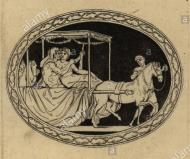
Volumnia Cytheris (fl. 1st-century BC) was an ancient Roman actress and mimae dancer. She is foremost known as the mistress of several famous Romans.
Possibly born around 70 B.C., she was originally a slave of Publius Volumnius Eutrapelius but later became a freedwoman. On stage, she was normally referred to only as Cytheris. The name derived from "Cythera" a nickname for Aphrodite. She had relationships with Brutus and Mark Antony, which attracted a lot of attention in contemporary ancient Rome. She is mentioned as the companion of her aristocratic lovers in social occasions when the presence of a courtesan was otherwise not common, and considered shocking.
Cicero's letters recount how embarrassed he was to go to a party that she also attended, and how offensive it was for Mark Antony to give her a place of dignity in his litter:
"The tribune of the people was borne along in a chariot, lictors crowned with laurel preceded him; among whom, on an open litter, was carried an actress; whom honourable men, citizens of the different municipalities, coming out from their towns under compulsion to meet him, saluted not by the name by which she was well known on the stage, but by that of Volumnia. A car followed full of pimps; then a lot of debauched companions; and then his mother, utterly neglected, followed the mistress of her profligate son, as if she had been her daughter-in-law. O the disastrous fecundity of that miserable woman! With the marks of such wickedness as this did that fellow stamp every municipality, and prefecture, and colony, and, in short, the whole of Italy."
Later, Cicero's wife asked Cytheris to help mend the relationship between her husband and Cytheris' lover Mark Antony, so that he could return from exile in Brundisium.
Her rejection of Cornelius Gallus reportedly provided the theme for Virgil's tenth Eclogue. Gallus refers to her in his work under the name Lycoris, which alludes to one of the names "Lycoreus" the god Apollo, Greek god of music.
She is one of few free influential Roman courtesans mentioned by her contemporaries, others being Praecia and Chelidon. Cytheris' fate is unknown and she is not mentioned in any sources after a certain point.
Les mer...